Maternity leave: the AI gender gap’s unexpected advantage
What the data says about women and AI, and why I'm optimistic for women returning to work.
It didn’t surprise me when Lean In published its latest research showing a significant gender gap in AI adoption. Men are 22% more likely to use AI daily at work: 33% of men compared to 27% of women.
I assumed this was happening. But it was a Harvard and OpenAI research paper How People Use ChatGPT that gave me the data point I couldn’t stop thinking about.
The paper tracks ChatGPT’s growth since its launch in November 2022. It shows that early adopters were overwhelmingly male, around 80% in the first few months. By mid-2025, the gender split had reached near-parity. But that parity masks an important fact: men had a two-year head start.
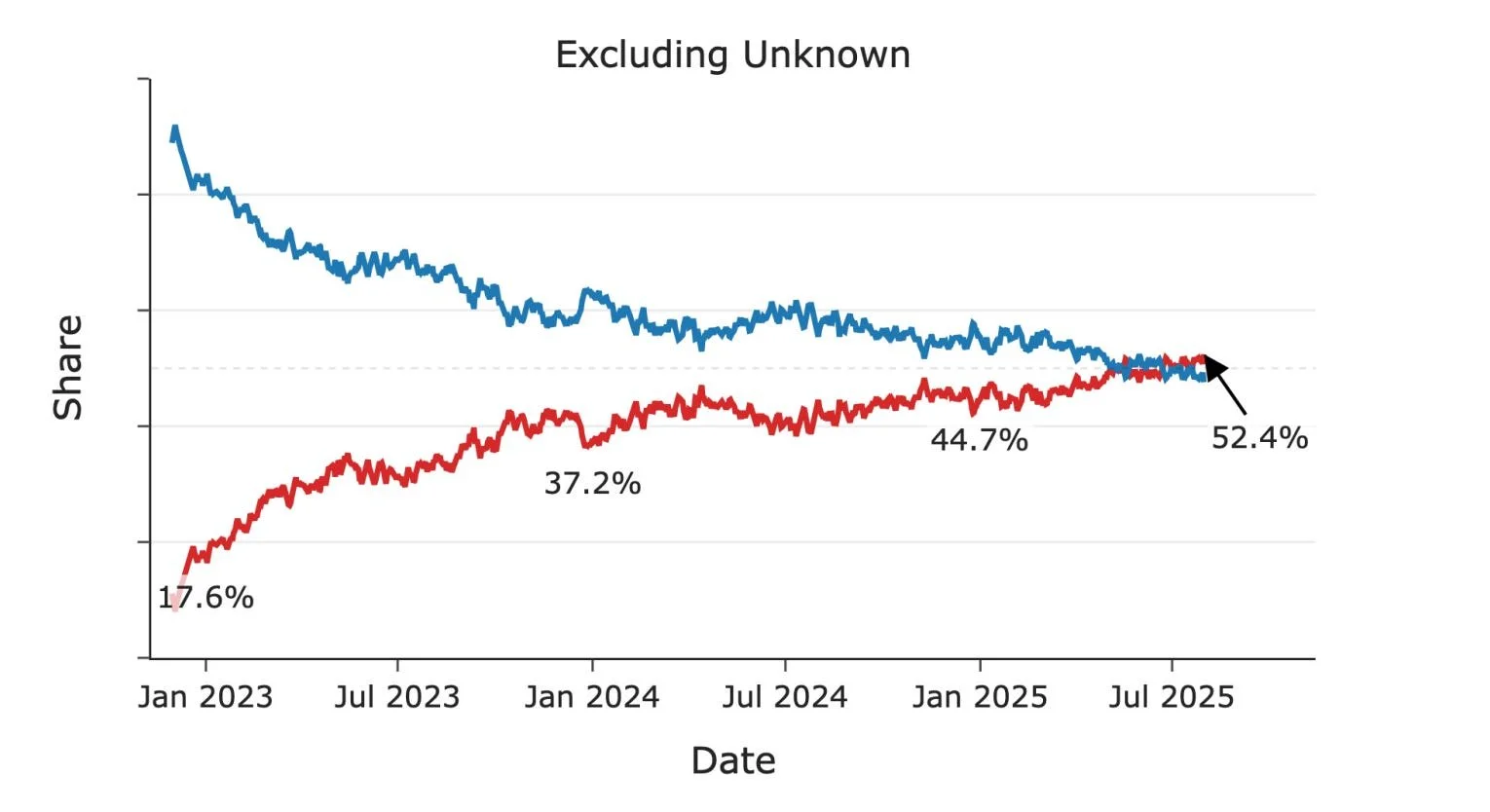
Red line = typically feminine names, blue line = typically masculine names. The chart excludes names where gender is unknown.
Two years of daily practice. Two years of building fluency. Two years of figuring out how to use AI not just for chatting, but for decision-making, writing, strategy, problem-solving, building habits and shortcuts. So yes, women may be using ChatGPT at similar rates to men now. But it’s reasonable to assume that how we’re using it isn’t level and that the average man will be operating at a higher level than the average woman, simply because they started using it earlier.
Now layer on maternity leave.
I work with women who have been out of the workforce for 3 months to 1 year. And what I’m hearing right now is unlike anything I’ve heard before. The pace of change inside organisations is unprecedented. Women are coming back to completely different workflows, new tools they’ve never seen, restructured teams, and a backdrop of AI-driven job insecurity (layered on top of the maternity-related job insecurity!).
It’s challenging enough that women are returning to elevated expectations of AI usage, leaderboards tracking adoption, and entirely new systems. But some can’t even access their email or laptop, having been locked out for failing to complete mandatory training or sign updated codes of conduct while on leave.
So we have a compounding problem. Women start later. And when they take maternity leave, they fall further behind at a moment when technology is moving the fastest. A joint study by the Brookings Institution and GovAI found that of the 6 million workers most exposed to AI and least equipped to adapt, 86% are women.
The return to work has always been daunting. But now, it’s scarier and more disorienting than ever.
All that said, I am and always will be an optimist. And actually, I see the maternity transition as a time with unique ingredients that can give women an edge, not a setback.
Time away doing the labour of love (caring for babies) gives women the space to gain perspective in an extremely disorienting and fast-moving world. It’s easy to feel like success and “keeping up” is about having skills, AI use and proficiency. I disagree.
What we are experiencing is a massive transition for both the workforce and society. And to be successful, we need to stay centred, informed and steady. These are skills motherhood develops. As we learn to regulate a baby’s emotions, we practise regulating our own, dealing with ambiguity and complexity, and learning as we go.
Maternity leave doesn’t have to be the chapter where you fall behind, but it's the chance to develop the steadiness that everyone else is scrambling for.
At Branch, we’re looking to help women cultivate this. And if this is you, you can join us. Here’s what we’re doing:
We’re launching Branch Book Club, an audiobook club for women who are pregnant, on maternity leave, or recently returned to work. The idea is simple. While you’re out, you stay connected to the conversations that matter: AI, the future of work, and professional growth. You don’t come back cold, but curious, and informed with a critical eye.
In our return-to-work cohorts, we’re building in AI orientation and critical thinking. Not technical training, but context and frameworks that give you the confidence to navigate this moment.
And we’re working with our employer partners to ensure AI inclusion and onboarding is done thoughtfully. This means women on leave aren’t left out of the loop as their organisations transform in their absence.
Motherhood builds calm under pressure, adaptability in the face of the unknown, and the confidence to figure it out as you go. In a world where every workplace is being re-designed around AI, these might be the most important skills of all.